ZillyPlanet

Role

Role

Product Designer

Platform

Platform

Responsive Web Design

Duration

Duration

Ongoing

Year

Year

2026

Turning Student Performance Into Actionable Support

ZillyPlanet's original educator experience was built as an MVP for Math. As the platform prepared to expand across subjects, the experience needed to evolve into a more flexible system that could surface meaningful learning insights across different types of content.

I led the redesign of the educator experience, working with the co-founder/product manager and engineering to evolve existing patterns, incorporate educator feedback, and help teachers move from "How is this student doing?" to "How can I help this student?"

My work spans student, parent, and educator experiences and has contributed to a design system of 100+ reusable components across 27 product surfaces.

Challenge

The Math MVP relied heavily on measures like accuracy and problem-solving, but those patterns couldn't simply be applied across every subject. Science, for example, requires understanding how students apply concepts, analyze evidence, and construct explanations.

The challenge was creating an educator experience flexible enough to surface meaningful insights across subjects while helping teachers quickly move from classwide patterns to individual needs and actionable support.

Without behavioral data from active users, early decisions were informed by educator interviews, secondary research, competitive analysis, educator personas, and existing product patterns.

Spotting Patterns Across the Class

Problem: Science performance couldn't be understood through accuracy alone. Teachers needed to quickly see how students were performing across distinct competencies and identify where support might be needed.

Design: I evolved the existing class performance view into a competency-based experience that surfaces student progress across learning areas using clear mastery states.

Why: Organizing performance around competencies allows teachers to scan for patterns across the class and identify students or concepts that may require additional attention.

Once an educator identified a student who might need support, the next challenge was helping them understand why and determine what to do next.

Simplifying What Matters

Our first exploration gave educators a comprehensive view of student performance, including progress, growth, competency performance, challenge levels, and learning signals.

Insights from educator interviews, combined with continued feedback from the product team, led us to question whether more information was necessarily more useful.

This led us to reframe the problem around 2 questions:


Does this student need help? If so, what can I do right now?

I used that insight to simplify the experience around interpreted signals and actionable support, prioritizing what educators needed to know over everything we could show them.

Our first exploration gave educators a comprehensive view of student performance, including progress, growth, competency performance, challenge levels, and learning signals.

Through educator interviews and feedback from the product team, we learned that more information wasn't necessarily more useful. In the moment, educators needed to answer two questions quickly:


Does this student need help? If so, what can I do right now?


I used that insight to simplify the experience around interpreted signals and actionable support, prioritizing what educators needed to know over everything we could show them.

Our first exploration gave educators a comprehensive view of student performance, including progress, growth, competency performance, challenge levels, and learning signals.

Insights from educator interviews, combined with continued feedback from the product team, led us to question whether more information was necessarily more useful.

This led us to reframe the problem around 2 questions:


Does this student need help? If so, what can I do right now?

I used that insight to simplify the experience around interpreted signals and actionable support, prioritizing what educators needed to know over everything we could show them.

Turning Data Into Action

Identifying that a student may need support is only useful if an educator can understand why and know what to do next. I designed the student performance experience to move teachers from a high-level signal to the underlying evidence, then surface targeted actions they could take to support the student.
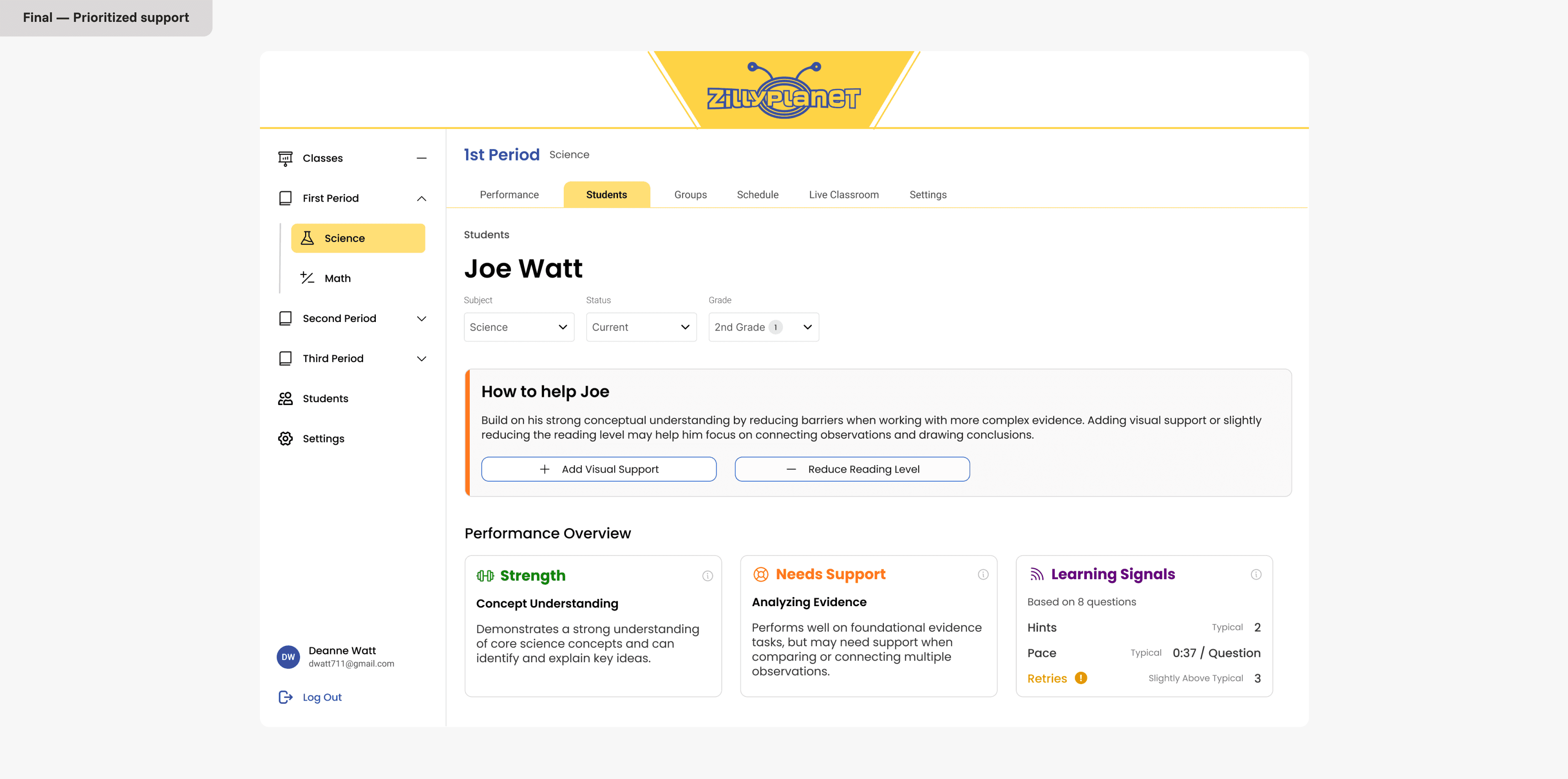
01 Identify the signal
Strengths and areas needing support surface the most important patterns first, helping educators quickly understand where a student is succeeding or struggling.

02 Understand the context
Learning signals and competency-level performance provide deeper context around why a student may be struggling, from retries and pace to specific areas of mastery.

03 Take action
Recommended supports translate those insights into concrete next steps, such as adding visual support or reducing reading complexity.

01 Identify the signal
Strengths and areas needing support surface the most important patterns first, helping educators quickly understand where a student is succeeding or may need support.

02 Understand the context
Learning signals and competency-level performance provide deeper context around why a student may need support, from retries and pace to specific areas of mastery.

03 Take action
Recommended supports translate those insights into concrete next steps, such as adding visual support or reducing reading complexity.

Designing Across the Learning Platform

The educator experience is one part of my broader role at ZillyPlanet. As the platform expanded across subjects and user types, I also designed new student learning workflows, progression patterns, and reusable components supporting student, parent, and educator experiences

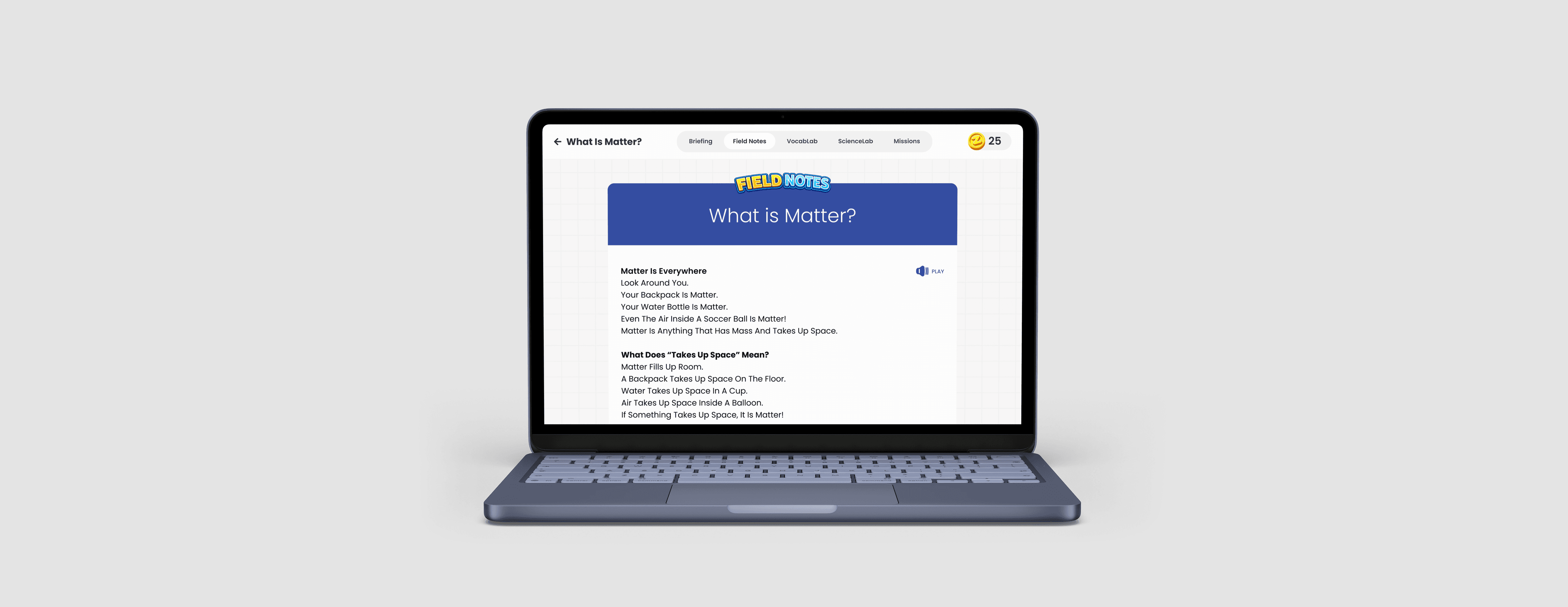
Building on the existing Math experience, I designed the Science learning architecture to support additional modules, flexible navigation, and new progression states. Students could enter lessons from multiple entry points, revisit completed activities, or explore content out of sequence, so I created a navigation model that encouraged a recommended learning path without limiting exploration.

Designed to:

  • Guide students without restricting exploration

  • Adapt entry points for first-time and returning learners

  • Let students resume where they left off

  • Account for edge cases and progression states for implementation

Designed to:

  • Guide students without restricting exploration

  • Adapt entry points for first-time and returning learners

  • Let students resume where they left off

  • Account for edge cases and progression states for implementation

Designed to:

  • Guide students without restricting exploration

  • Adapt entry points for first-time and returning learners

  • Let students resume where they left off

  • Account for edge cases and progression states for implementation

From Workflow to Interface

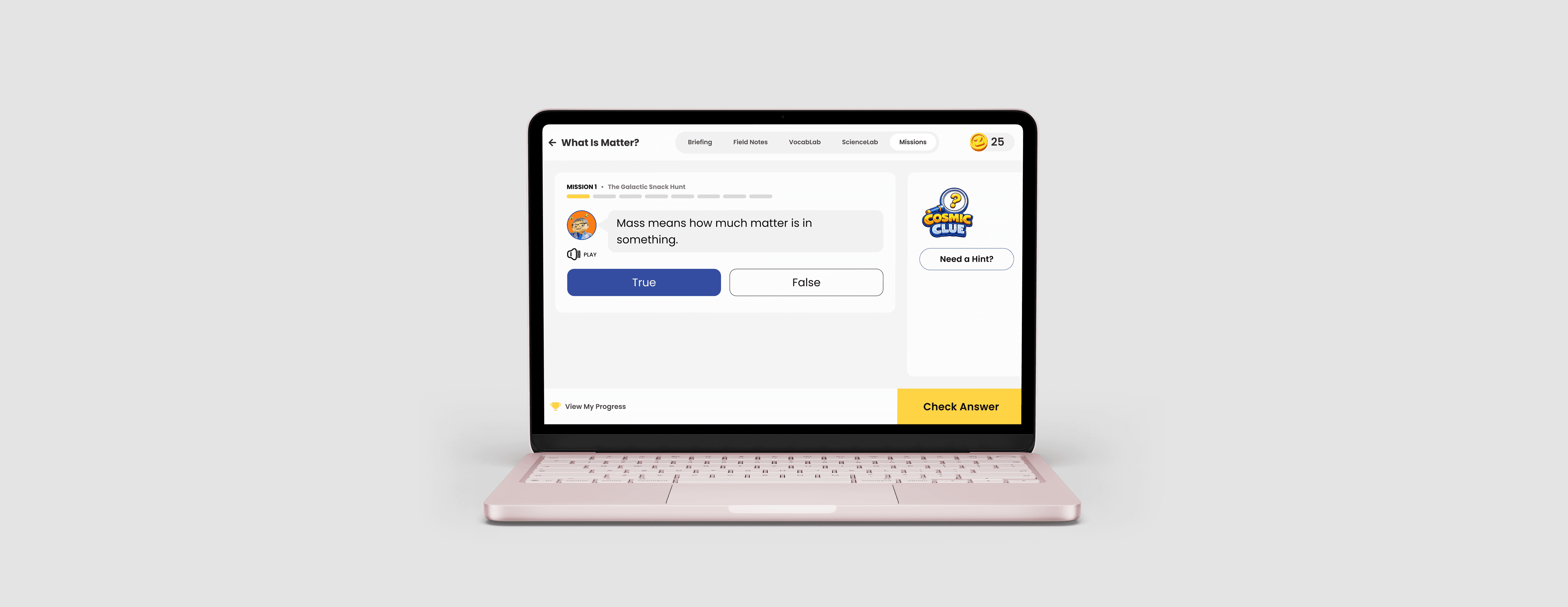
The resulting interface translated the workflow into a flexible learning experience, guiding students through each stage while maintaining consistent navigation and visual patterns across modules.

The resulting interface translated the workflow into a flexible learning experience, guiding students through each stage while maintaining consistent navigation and visual patterns across modules.

Science Navigation

Science Navigation

Science Navigation

Field Notes

Field Notes

Field Notes

Vocabulary Lab

Vocabulary Lab

Missions

Mission

Making Progress Clear

Students needed a clearer way to understand what they'd completed and what remained to master a skill. Early concepts emphasized gamification through streaks and coin rewards, but through review with the founder and PM, we found these elements competed with the more important question: What should I learn next?

I simplified the experience around mastery progression, surfacing completed concepts, what remained, and unlock conditions across practice and challenge modes, while allowing students to revisit completed activities for additional practice.

Building a Foundation for Scale

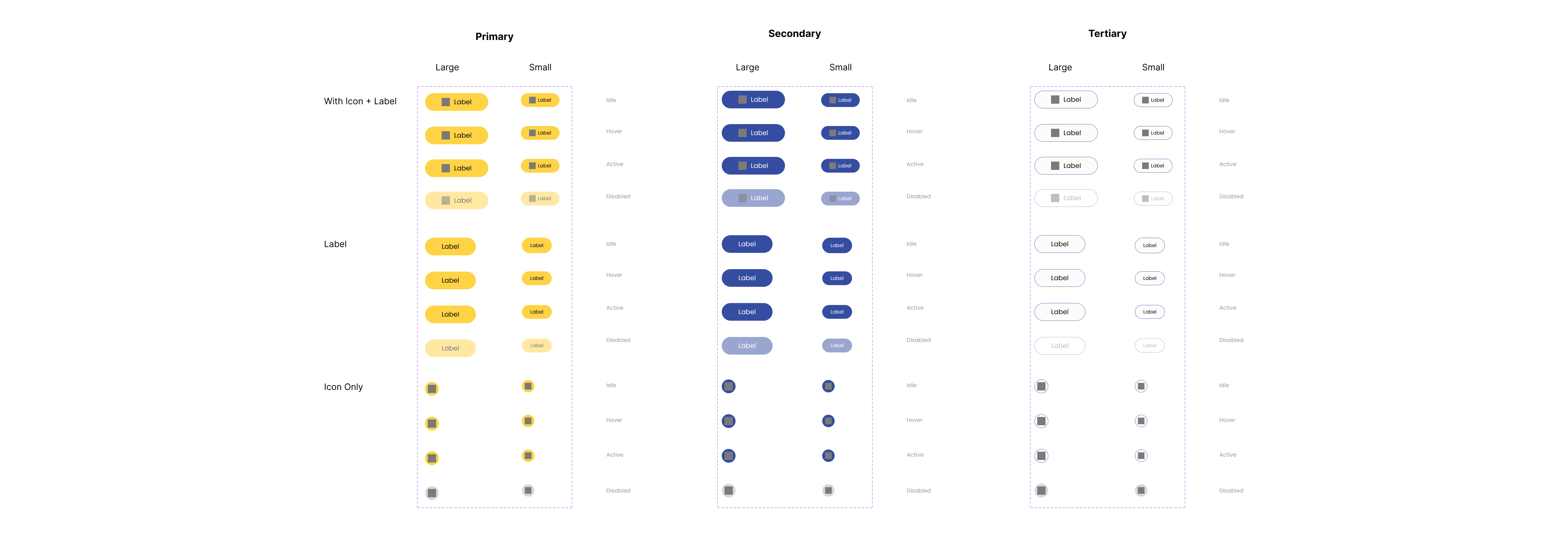
To support continued growth, I audited and evolved the design system to support new experiences without reinventing patterns for every feature. Shared foundations maintained consistency across the platform, while flexible variants allowed the product to adapt from accessible, engaging student experiences to denser, data-rich experiences for educators.
27
Product surfaces

27
Product surfaces

27
Product surfaces

100+
Reusable components

100+
Reusable Components

100+
Reusable components

3
User Groups

3
User Groups

3
User Groups

Role

Product Designer

Platform

Responsive Web Design

Duration

Ongoing

Year

2026

Impact

My work has helped ZillyPlanet evolve its educator experience, expand from existing Math experiences into Science, and establish reusable patterns for continued product growth.


  • From data to action: Evolved educator workflows from class-wide performance patterns to individual learning signals and targeted support


  • From Math to Science: Designed new learning workflows and progression patterns while adapting existing patterns to the distinct ways Science learning is navigated and evaluated


  • Built to scale: Built and evolved a design foundation of 100+ reusable components supporting 27 product surfaces across student, parent, and educator experiences

  • Product Impact

    • Designed and shipped the Progress Dashboard, now powering mastery tracking across math and science.

    • Created a scalable system supporting students, parents, and educators across web and mobile.

    Team Impact

    • Built 100+ reusable components across 27 product surfaces.

    • Reduced design inconsistencies through standardized documentation and component usage guidelines.

    • Enabled 20% faster development through implementation-ready component specifications.

  • Built 100+ reusable components adopted across 27 product surfaces

  • Reduced design inconsistencies through clear documentation standards for component usage and variants

  • Enabled 20% faster development cycles through comprehensive component specs and usage guidelines

  • Designed and shipped the Progress Dashboard, now powering mastery tracking across math and science

  • Created a scalable system supporting three distinct user types (students, educators, and parents) across web and mobile

Reflection

Working at an early-stage startup has taught me to get comfortable designing without always having a clear roadmap or perfect information. I've learned to find other ways to make informed decisions when research is limited, collaborate closely with product and engineering, and stay flexible as priorities and requirements evolve.

Designing across students, parents, and educators has also pushed me to think beyond a single type of user. Each group has different goals, needs, and levels of complexity, and I've learned to adapt the experience while still making the product feel connected as a whole.
other projects

other projects

other projects